
Germany is now the #1 tuition-free study destination in Europe for Pakistani students — and one of the very few countries in the world where you can earn a globally respected degree without paying tuition fees and without taking IELTS. With over 450 public universities, 180+ English-taught master’s programs, an 18-month post-study job-seeker visa, and a clear path to permanent residency, Germany offers what almost no other country can: world-class education at near-zero cost.
But here’s the catch most Pakistani students think they can skip IELTS for Germany, only to discover at the last minute that their chosen university still requires it. The rules around “Study in Germany without IELTS” are real, but they are specific, conditional, and often misunderstood. This guide written by TheUniGrad’s Germany admissions team explains exactly when you can skip IELTS, what alternatives are accepted, and how to apply step by step in 2026.
Is It Really Possible to Study in Germany Without IELTS?
Yes but with conditions. German universities do not legally require IELTS the way UK or Australian universities do. What they require is proof of English proficiency for English-taught programs, or proof of German proficiency (typically TestDaF or DSH) for German-taught programs. IELTS is just one of several accepted ways to prove that English ability.
This means that if you can prove your English proficiency through another accepted method such as a Medium of Instruction (MOI) letter, a previous English-medium degree, or a Duolingo / PTE / TOEFL score many German universities will waive the IELTS requirement entirely.
In Germany, IELTS is not the law it’s just the most common option. Pakistani students who studied their bachelor’s in English at HEC-recognised universities have a real, documented path to apply without ever sitting an IELTS test.
Who Qualifies for an IELTS Waiver?
You are most likely to qualify for an IELTS waiver in Germany if you meet one or more of the following conditions:
- Your previous degree (Matric, FSc, or Bachelor’s) was completed in English medium at an HEC-recognised institution in Pakistan
- Your university issues you a Medium of Instruction (MOI) letter on official letterhead confirming the language of instruction was English
- You have a Cambridge English certificate (CAE / CPE / FCE) at C1 level or above
- You hold a TOEFL iBT score of 80+ or a PTE Academic score of 59+
- You have a Duolingo English Test (DET) score of 110+ (accepted by a growing number of German universities)
- You are applying for a German-taught program and can prove German proficiency at B2/C1 level instead
Accepted Alternatives to IELTS
Below is a comparison of the most commonly accepted IELTS alternatives for German universities in 2026:
1. Medium of Instruction (MOI) Letter
The simplest and cheapest option. A signed and stamped letter from your previous Pakistani university stating that the entire program was taught and examined in English. Accepted by approximately 30–40% of German universities, especially Universities of Applied Sciences (Fachhochschulen).
2. PTE Academic
Computer-based, fast, and increasingly popular. A score of 59+ overall is generally accepted in place of IELTS 6.5. Results come within 48 hours. Learn more about PTE Academic preparation with TheUniGrad.
3. TOEFL iBT
The most globally recognised IELTS alternative. A score of 80+ (with 20+ in each section) is the standard requirement at most German universities.
4. Duolingo English Test (DET)
The cheapest option (~USD 65) and taken from home. A score of 110+ is accepted by a growing list of German universities, especially private institutions like IU International University, GISMA, and Arden University Berlin.
5. Cambridge English (C1 Advanced / C2 Proficiency)
Universally accepted across Germany and valid for life. Best for students who already hold this certification from school or college.
Top German Universities Offering IELTS Waivers
The following universities are known to accept MOI letters or alternative English tests in place of IELTS for Pakistani applicants. Always verify the latest policy on the official program page before applying.
- University of Siegen — Accepts MOI letters for many engineering master’s programs
- Technische Hochschule Köln (TH Köln) — Accepts TOEFL, PTE, and Cambridge in lieu of IELTS
- Hochschule Schmalkalden — MOI letter accepted for several MBA and engineering programs
- University of Freiburg — Accepts a wide range of English proficiency proofs
- IU International University of Applied Sciences — Accepts Duolingo, PTE, TOEFL, and internal English test
- GISMA Business School — Accepts Duolingo and conducts its own online English assessment
- Hof University of Applied Sciences — MOI letter accepted for most master’s programs
- Anhalt University of Applied Sciences — Accepts MOI and TOEFL/PTE alternatives
- BSBI (Berlin School of Business & Innovation) — Flexible English proficiency policy
- Esslingen University of Applied Sciences — Accepts TOEFL and Cambridge alternatives
Universities of Applied Sciences (Fachhochschulen / HAW) are generally more flexible with English proficiency requirements than traditional research universities. If avoiding IELTS is your priority, prioritise applied sciences universities.
English-Taught Programs You Can Apply For
Germany now offers more than 1,800 fully English-taught degree programs across bachelor’s, master’s, and PhD levels. The most popular fields among Pakistani students are:
- Mechanical, Electrical, and Automotive Engineering
- Computer Science, Data Science, and Artificial Intelligence
- Business Administration & MBA
- Renewable Energy & Environmental Engineering
- Biotechnology, Biomedical Engineering, and Pharmacy
- Logistics & Supply Chain Management
- Industrial Engineering & Management
- Information Technology & Cybersecurity
You can search the official DAAD (German Academic Exchange Service) database at daad.de/international-programmes to filter all English-taught programs by subject, level, and tuition fee.
Document Checklist for Pakistani Students
To apply to a German university (with or without IELTS), you’ll need the following documents all attested by HEC and translated where required.
Academic Documents
- Matriculation (10th grade) certificate and transcript
- Intermediate (FSc / FA / A-Levels) certificate and transcript
- Bachelor’s degree and full transcripts (for master’s applicants)
- HEC Equivalence Certificate (if applying to undergraduate programs)
- HEC attestation of all degrees and transcripts
English Proficiency Proof (one of the following)
- MOI letter from your previous Pakistani university
- PTE Academic, TOEFL iBT, Duolingo, or Cambridge English certificate
- IELTS (if you choose this option, minimum 6.0–6.5 overall)
Other Required Documents
- Updated CV / Europass resume
- Statement of Purpose (SOP) — 800–1,000 words
- Two academic Letters of Recommendation (LORs)
- Valid Pakistani passport (with at least 12 months validity)
- APS Certificate (Akademische Prüfstelle) — mandatory for all Pakistani applicants since November 2022
- Motivation letter specific to each university
- Work experience letters (if applicable)
Step-by-Step Application Process
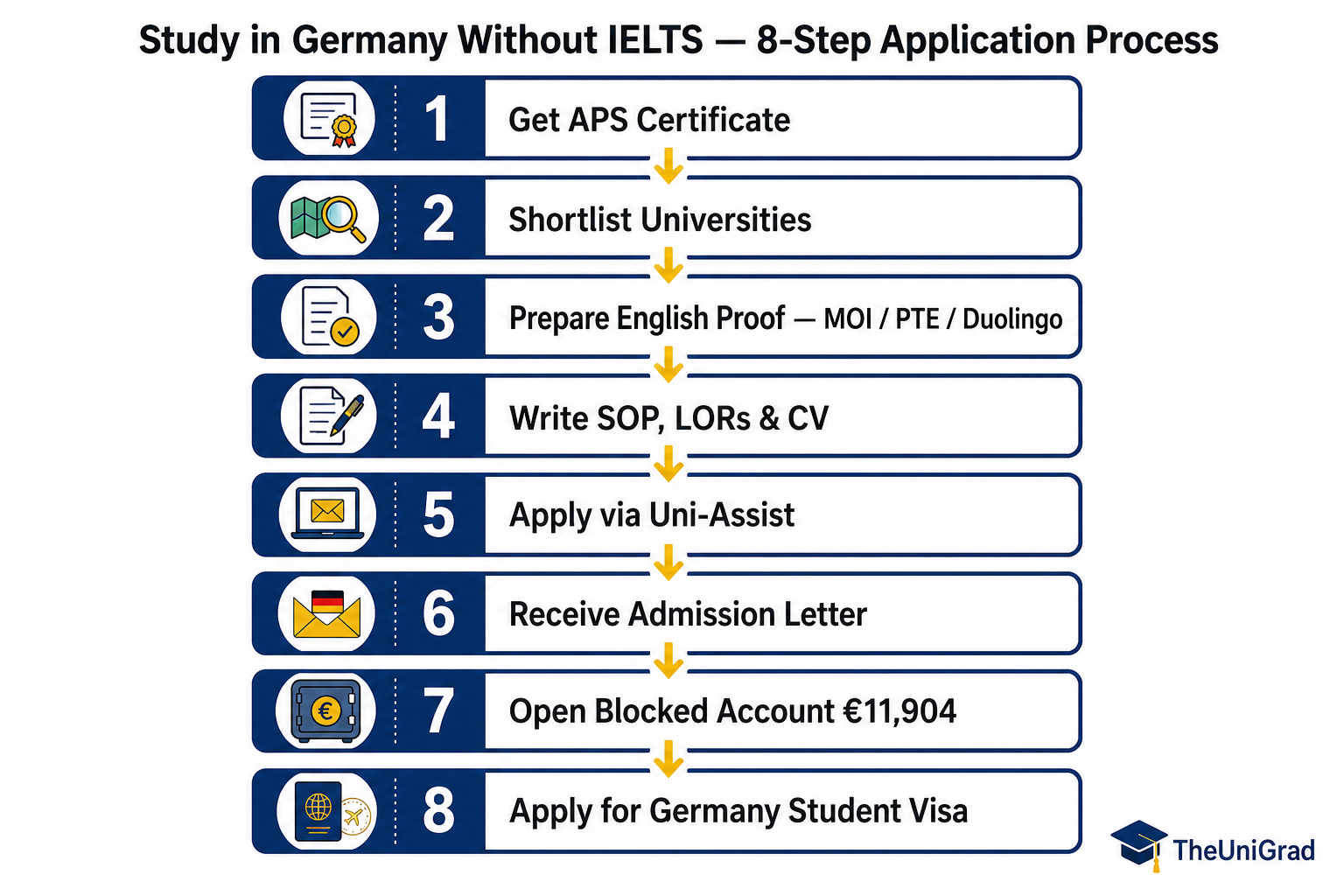
Step 1 — Get Your APS Certificate (Mandatory)
The APS (Akademische Prüfstelle) certificate is now compulsory for every Pakistani student applying to a German university. It verifies that your previous degrees are genuine and meet German entry standards. Apply through the German Embassy in Islamabad — the process takes 8–12 weeks and costs approximately EUR 250.
Step 2 — Shortlist Universities & Programs
Use the DAAD portal to filter English-taught programs that explicitly accept MOI or alternative English proofs. Shortlist 6–8 universities (a healthy mix of safe, target, and ambitious choices).
Step 3 — Prepare Your English Proficiency Proof
If you don’t qualify for an MOI waiver, take the PTE Academic or Duolingo test — both are faster and cheaper than IELTS. TheUniGrad’s language prep team can help you choose the right test for your target universities.
Step 4 — Prepare Your SOP, LORs, and CV
Tailor your SOP for each university — generic, copy-pasted SOPs are the #1 reason for rejection at top German universities. Mention specific professors, research labs, or modules that match your goals.
Step 5 — Submit Applications via Uni-Assist or Direct Portal
Most German universities require applications through the centralised Uni-Assist platform (uni-assist.de). A few accept direct online applications. Application fees range from EUR 75 (first uni) + EUR 30 (each additional).
Step 6 — Receive Admission Letter (Zulassungsbescheid)
Decisions arrive 4–8 weeks after the application deadline. Once admitted, you’ll receive an official admission letter — the document you’ll need for the next step.
Step 7 — Open a Blocked Account (Sperrkonto)
Deposit EUR 11,904 (the 2026 minimum) into a German blocked account at Expatrio, Fintiba, Coracle, or Deutsche Bank. This proves you can financially support yourself for one year.
Step 8 — Apply for the Germany Student Visa
Submit your visa application at the German Embassy in Islamabad or the German Consulate in Karachi. Standard processing takes 6–12 weeks apply at least 3 months before your intended travel date.
Blocked Account & Financial Requirements (2026)
Germany requires every international student to prove they can support themselves for one year of study. As of January 2026, the official minimum amount is:
- Annual minimum: EUR 11,904 (~PKR 36 lakh)
- Monthly withdrawal limit: EUR 992 per month
- Where to deposit: Expatrio, Fintiba, Coracle, or Deutsche Bank blocked account
- Setup time: 5–10 working days online
Alternatives to a blocked account include a formal scholarship letter (DAAD, Erasmus+, etc.), a recognised sponsor in Germany (Verpflichtungserklärung), or a bank guarantee. However, the blocked account is by far the most common and simplest route for Pakistani students.
Germany Student Visa Process from Pakistan
Once you have your admission letter and blocked account confirmation, you can apply for the German National Visa (Type D) for studies. Documents required:
- Admission letter (Zulassungsbescheid) from a German university
- APS Certificate
- Blocked account confirmation (EUR 11,904)
- Health insurance certificate (Mawista, Care Concept, or DR-WALTER)
- Academic documents (HEC attested)
- English proficiency proof (or MOI letter)
- Motivation letter and CV
- Visa application form (signed twice)
- 3 biometric passport photos (35 × 45 mm)
- Visa fee EUR 75 (paid in PKR equivalent)
The German Embassy in Islamabad is one of the busiest in South Asia. Visa appointment slots open 3–6 months in advance and fill within hours. Book your slot the moment your admission letter arrives.
Total Cost of Studying in Germany in 2026
Germany is famous for being affordable — but here is what your true year-one cost will look like as a Pakistani student:
- Tuition fees (public universities): EUR 0 (only a semester contribution of EUR 150–350)
- Tuition fees (private universities): EUR 8,000–20,000 per year
- Living costs (Berlin, Munich, Frankfurt): EUR 1,000–1,300 / month
- Living costs (smaller cities like Siegen, Schmalkalden, Anhalt): EUR 700–900 / month
- Health insurance: EUR 120 / month (~EUR 1,440 / year)
- APS Certificate: EUR 250 (one-time)
- Blocked account setup fee: EUR 50–150
- Visa fee: EUR 75
- Flights (Pakistan → Germany, one-way): PKR 200,000–280,000
Estimated first-year total (public university): EUR 13,000–15,000 (~PKR 40–46 lakh) significantly lower than the UK, Australia, or USA.
Ready to Start Your Germany Journey?
Studying in Germany without IELTS is 100% possible but it requires the right university choices, the right document strategy, and the right timeline. At TheUniGrad, we have helped hundreds of Pakistani students secure admissions and visas to German public and private universities, with or without IELTS. Our team will tell you honestly whether you qualify for an IELTS waiver and which universities are the best match for your profile.